


Dabur India Limited is one of the most trusted FMCG companies in India, known for its strong presence in healthcare, personal care, and food products. Investors are increasingly searching for Dabur India Share Price Target to understand the company’s long-term growth potential and stability. With a legacy of over a century, Dabur has built a strong brand portfolio that includes products in ayurvedic healthcare, oral care, hair care, and packaged foods.
The company benefits from consistent demand for consumer goods, especially in rural and semi-urban markets. Its focus on natural and herbal products gives it a competitive edge in the growing wellness segment. The Dabur India Share Price Target 2025, 2026, 2030, 2035, 2040, 2045, 2050 is influenced by factors such as revenue growth, profit margins, market expansion, and changing consumer preferences.
With steady financial performance, strong distribution network, and increasing export presence, Dabur remains a reliable player in the FMCG sector. This article provides a detailed analysis of its business model, financials, and growth outlook to help investors understand future price potential.
Company Overview
Dabur India Limited is a leading FMCG company specializing in ayurvedic and natural consumer products. The company operates across multiple segments, including healthcare, personal care, and food and beverages. Its popular brands such as Dabur Honey, Dabur Chyawanprash, Real Juices, and Vatika have strong market recognition.
Dabur has a wide distribution network covering urban and rural markets, allowing it to reach a large customer base. The company also has a strong international presence, especially in the Middle East, Africa, and Southeast Asia.
With increasing demand for herbal and natural products, Dabur is well-positioned for long-term growth. Its focus on innovation, product diversification, and brand strength plays a key role in shaping the Dabur India Share Price Target and overall business expansion.
Dabur India Financial Overview
Current Share Price
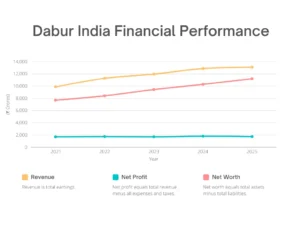
Dabur India achieves steady financial growth because its customers show strong brand loyalty and maintain constant demand for its healthcare and personal care products. The company shows revenue growth during the past five years because it has expanded its business activities yet maintains operational effectiveness through its ability to generate consistent profits. The company’s increasing net worth boosts its balance sheet strength and establishes financial stability which will support upcoming business growth.
Revenue and Profit Growth
| Year | Revenue | Net Profit | Net Worth |
|---|---|---|---|
| 2021 | 9,887 | 1,695 | 7,700 |
| 2022 | 11,282 | 1,742 | 8,422 |
| 2023 | 11,975 | 1,701 | 9,441 |
| 2024 | 12,886 | 1,811 | 10,303 |
| 2025 | 13,113 | 1,740 | 11,210 |
5 Years Financial Growth Analysis
Fundamental Metrics (As of February 2026)
| Metrics | Values |
|---|---|
| Current Share Price | ₹510.00 |
| 52-Week Range | ₹433.30 – ₹577.00 |
| Market Capitalisation | ₹88,968 Cr |
| P/E Ratio (TTM) | 48.89 |
| Industry P/E | 50.43 |
| P/B Ratio | 8.12 |
| Debt to Equity | 0.12 |
| ROE | 16.51% |
| EPS (TTM) | 10.26 |
| Book Value | ₹61.78 |
| Dividend Yield | 1.59% |
| Face Value | ₹1 |
| Website | Dabur |
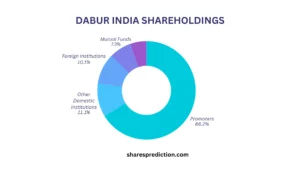
The promoter holding of over 66% reflects strong management confidence, while consistent institutional participation from FIIs and mutual funds signals stable investor trust in Dabur’s long-term FMCG business growth trajectory.
Factors Influencing Dabur India Share Price Target
Multiple business and macroeconomic factors shape the Dabur India Share Price Target because these factors directly determine the company’s revenue and profit capacity and how investors perceive the stock. The identification of these drivers enables stock performance analysis over extended periods.
1. Consumer Demand Trends
Dabur experiences sales growth because more consumers choose herbal and Ayurvedic and natural products due to their increasing health awareness. The company generates revenue through strong customer demand across its healthcare and personal care and food business segments.
2. Raw Material Costs
The company experiences changes in operating margins because its expenses for herbs and packaging materials and crude-derived products fluctuate. The company faces temporary profit declines because inflation rates create financial pressures.
3. Rural and Urban Market Growth
Dabur has established a strong presence in rural markets. The company achieves volume growth through its rural distribution expansion and increasing rural income levels.
4. International Business Performance
International markets contribute a major part of the company’s total revenue. The company’s earnings growth depends on three main factors, which include currency exchange rates and geopolitical stability and regional demand patterns.
5. Product Innovation & Brand Strength
The company improves its market position through ongoing product development and its established brand value which enables it to retain market share against competitors in the fast-moving consumer goods industry.
6. Competitive Landscape
The existence of multiple competing FMCG businesses creates challenges for companies because it restricts their ability to set prices and results in higher advertising expenses which decreases their overall profitability.
7. Regulatory Environment
Business operations and cost structures experience changes because of government policies that control healthcare standards food safety regulations and taxation procedures and export controls.
8. Economic Conditions
The sales growth and stock market performance of a company depend on macroeconomic factors such as GDP growth and disposable income and inflation rates and consumer spending patterns.
The combined impact of these elements determines how much revenue will increase and how much earnings will grow and how much investors will trust the company which will decide Dabur India’s future stock price target.
Dabur India Share Price Target 2025
The Dabur India Share Price Target 2025 was estimated in the range of ₹510 to ₹525, reflecting stable performance in the FMCG sector.
Dabur India Limited operates in health care, personal care, and food products, benefiting from strong brand recognition and consistent consumer demand. The company maintained steady revenue growth supported by its wide distribution network and diversified product portfolio. Increasing demand for Ayurvedic and natural products further strengthened its outlook. However, factors such as input cost fluctuations and rural demand trends influenced short-term price movement. Overall, the Dabur India Share Price Target 2025 indicated moderate growth driven by stable consumption demand.
Dabur India Share Price Target 2026
The increasing consumer demand for herbal FMCG products together with the consistent growth of domestic market consumption will result in Dabur India’s moderate profit expansion throughout 2026. The 2026 share price target base on EPS growth reaching between ₹11 and ₹12 with stable P/E valuation at present levels results in:
Share Price Target Range of ₹560 to ₹610
Dabur India’s 2026 share price target shows how the company maintains solid growth across India’s fast-moving consumer goods market through its strong brand recognition and consumer demand for its Ayurvedic and healthcare products. Dabur India will achieve consistent revenue expansion through its initiatives to enhance rural market reach and introduce new products and its digital sales channels, which will result in an optimistic 2026 share price forecast for medium-term investors.
Dabur India Share Price Target 2030
Dabur India plans to establish a major presence in the worldwide natural healthcare and personal care markets by the year 2030. EPS will increase to ₹18–₹20 because the company anticipates earnings to grow at a CAGR of 10–12% while its valuation will undergo gradual re-rating, which leads to a potential share price target range of:
Share Price Target Range of ₹900 to ₹1,050
The Dabur India Share Price Target 2030 demonstrates how the company will achieve long-term growth through research and development, international market entry, and the rising health consciousness among consumers. Dabur expects its strategic investments and improved operational efficiency to create major profitability growth which will drive stock performance until 2030 because of the rising global demand for herbal and natural personal care products.
Dabur India Share Price Target 2035
Dabur India will experience demand growth through its healthcare and wellness products because rural markets and international markets will continue to develop. The earnings growth and margin expansion will lead to EPS reaching between ₹25 and ₹28 by the year 2035.
The Dabur India Share Price Target 2035 considers the company’s ability to capitalize on emerging wellness trends and strengthen its position in both domestic and global markets. The company will achieve financial stability through its ongoing product development efforts and sustainable sourcing practices and its expanding consumer healthcare product assortment which will generate high returns for shareholders during the next ten years.
Dabur India Share Price Target 2040
The global expansion of distribution channels for premium herbal products will drive ongoing revenue growth for Dabur India. The company expects its earnings per share to grow between ₹35 and ₹40 while its stock valuation will remain constant.
Dabur India Share Price Target 2040 delivers its valuation based on demographic trends and increased consumer spending power and growing interest in organic and herbal products. The company will create operational efficiencies through its research-based product development efforts and supply chain management improvements which will generate significant investor value as its international presence expands.
Dabur India Share Price Target 2045
The analysis shows that Dabur India will make sustainable earnings progress until 2045 because of its strong brand presence and different product offerings. The estimated EPS will reach ₹50–₹58 level in the future which will result in:
The Dabur India Share Price Target 2045 projects future growth based on changing consumer behavior and rising interest in preventive healthcare products. Dabur India will achieve stable financial results through its existing distribution system and extensive market reach in developing regions which will benefit investors who want to maintain their investments while experiencing expansion.
Dabur India Share Price Target 2050
Dabur India will achieve sustainable business growth through its position as a market leader in ayurvedic products and natural healthcare solutions. The EPS will reach ₹70–₹80 level if domestic and export demand shows strong growth:
The Dabur India Share Price Target 2050 emphasizes the company’s long-term strategic vision and commitment to innovation in natural healthcare and FMCG products. Dabur will achieve consistent earnings growth and increased shareholder value through its ability to adjust to market changes which will drive its product development in response to rising global wellness trends and growing demand for herbal remedies.
Dabur India Shareholding Pattern
| Category | Holding (%) |
|---|---|
| Promoters | 66.23% |
| Other Domestic Institutions | 11.10% |
| Foreign Institutions | 10.06% |
| Mutual Funds | 7.28% |
| Retail & Others | 5.33% |
Conclusion
Dabur India shows solid financial health because it maintains steady profit growth while building a trustworthy brand portfolio across all its FMCG product lines. The company will achieve long-term growth between 2026 and 2050 because consumer demand for natural healthcare products increases and its international market presence expands while it offers reliable investment returns to long-term investors.
Frequently Asked Questions
Is Dabur India a good long-term investment?
Yes, Dabur India has strong brand value, stable financials, and growing demand for herbal products, making it a potentially reliable long-term investment option.
What does Dabur India mainly do?
Dabur India manufactures healthcare, personal care, and food products with a focus on natural and ayurvedic solutions.
What is the future growth outlook of Dabur India?
The company is expected to benefit from rising demand for natural wellness products and expanding international market presence.
Does Dabur India pay dividends?
Yes, Dabur India regularly pays dividends, offering consistent returns to long-term investors.
What factors affect Dabur India’s share price?
Consumer demand, raw material costs, competition, global expansion, and financial performance influence the share price.
Is Dabur India a debt-free company?
Dabur India maintains a low debt-to-equity ratio, reflecting strong financial discipline.
What is Dabur India’s main revenue segment?
Healthcare and personal care products contribute significantly to Dabur India’s revenue.
Can Dabur India grow in rural markets?
Yes, increasing rural consumption is expected to drive future sales growth.
Does Dabur India operate internationally?
Yes, Dabur India has a strong presence in various global markets.
Is Dabur India affected by inflation?
Yes, rising raw material costs due to inflation can impact profit margins.
Disclaimer
The article Dabur India Share Price Target 2025, 2026, 2030, 2035, 2040, 2045, 2050 has only informational value because it does not provide any financial or investment recommendations. The share price targets depend on three factors which include prevailing market conditions and the company’s current financial status and its anticipated future development. Investors need to complete their own research work or they should work with financial advisors before they proceed to make any investment choices.
Call To Action
Want deeper long-term insights on Dabur India Share Price Target 2025, 2026, 2030, 2035, 2040, 2045, 2050? Visit sharesprediction.com for expert analysis, updated forecasts, and detailed stock research to support smarter investment decisions.
