

The share price target for AYE Finance serves as a key metric which investors use to analyze performance within India´s micro and small business-focused non-banking financial institution industry. AYE Finance specializes in providing loans to micro and small businesses which face difficulties obtaining traditional banking services. AYE Finance establishes its market position through its increasing business profits and its expanding loan portfolio and its growing company value. The article presents the complete future prediction which extends from 2026 to 2050.
Company Overview
The Indian market recognizes AYE Finance as a non-banking financial company (NBFC) which provides business financing solutions to micro and small businesses throughout the country. The company uses a cluster-based lending model supported by data-driven underwriting to reduce credit risk.
The company provides its services to businesses that operate in the manufacturing and trading and service sectors.India’s MSME sector remains underpenetrated in terms of formal credit access which creates persistent growth potential for AYE Finance and other lenders. The economic cycle and funding expenses create sensitivity issues for non-banking financial companies according to their current operational pattern.
Profits and Revenue
The financial performance of AYE Finance recovered from its previous unstable period because its revenue growth and rising company value created a path toward profitability.
AYE Finance Financial Performance (₹ Crore)
| Year | Revenue | Net Profit | Net Worth |
|---|---|---|---|
| 2021 | 499 | 16.89 | 747 |
| 2022 | 443 | -45.72 | 706 |
| 2023 | 643 | 53.79 | 769 |
| 2024 | 1,072 | 161 | 1,236 |
| 2025 | 1,505 | 171 | 1,658 |
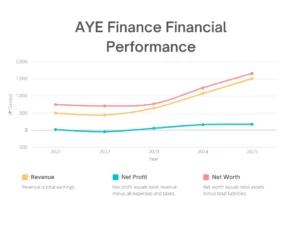
The company’s financial performance has improved through revenue growth while its operational efficiency shows progress, yet the organization needs to maintain its focus on developing consistent results.
Current Share Price
Financial Overview
| Metric | Value |
|---|---|
| Market Cap | ₹3,029 Cr |
| P/E Ratio (TTM) | 23.56 |
| P/B Ratio | 1.24 |
| ROE | 7.44% |
| EPS (TTM) | ₹5.21 |
| Dividend Yield | 0.00% |
| Debt to Equity | 3.04 |
| Industry P/E | 25.33 |
| Book Value | ₹98.79 |
| 52-Week High | ₹149.69 |
| 52-Week Low | ₹118.51 |
| Face Value | ₹2 |
AYE Finance trades near industry valuation levels. However, leverage and asset quality management remain critical for long-term stability.
Factors Influencing AYE Finance Share Price Target
MSME Credit Growth
India’s small business lending demand is structurally strong, supporting long-term loan book expansion.
Asset Quality Management
Maintaining low NPAs and disciplined underwriting will directly impact profitability.
Funding Cost and Liquidity
As an NBFC, borrowing costs significantly influence margins and earnings.
Regulatory Environment
NBFC regulations and RBI policies play an important role in long-term sustainability.
AYE Finance Share Price Target 2026
The AYE Finance share price target for 2026 is expected to reflect gradual stabilization in profitability and loan growth. The company will experience moderate valuation growth if it can maintain its revenue growth while keeping credit costs at manageable levels. Investors will closely track asset quality and funding costs. AYE Finance will gain investor confidence through better earnings visibility and higher demand from MSMEs but short-term market fluctuations will continue because of economic conditions.
AYE Finance Share Price Target 2030
AYE Finance Share Price Target 2035
The AYE Finance share price target for 2035 assumes the company achieves operational maturity and consistent earnings performance. At this point, fundamental investors will assess the company’s governance practices and asset management track record and financial statement strength. AYE Finance will gain greater market trust if it establishes multiple funding channels and effectively manages economic fluctuations. The structural expansion of India’s MSME financing industry will create ongoing positive effects.
AYE Finance Share Price Target 2040
AYE Finance Share Price Target 2045
The AYE Finance share price target for 2045 depends largely on its resilience during multiple credit cycles. The company will establish its financial success through three main factors which include its ability to maintain asset quality and its diverse funding sources and its consistent ability to generate returns on equity. The period will reach growth peak which will enable businesses to achieve stable earnings that investors will find more trustworthy. The company must maintain its ability to adapt to both digital transformation and changes in regulatory requirements.
AYE Finance Share Price Target 2050
Shareholding Pattern
The ownership distribution of AYE Finance Limited demonstrates substantial institutional control which foreign investors maintain as the primary institutional investors. Foreign Institutional Investors hold a substantial 70.37% stake, indicating significant global confidence in the company’s long-term growth prospects. The market shows low retail engagement because Other Domestic Institutions and Mutual Funds combine to maintain only a small market share. The ownership structure of the company maintains institutional control which establishes stable operations through backing from domestic and retail investors.
| Shareholder Category | Shareholding (%) |
|---|---|
| Foreign Institutional Investors | 70.37% |
| Other Domestic Institutions | 13.35% |
| Retail & Others | 11.46% |
| Mutual Funds | 4.82% |
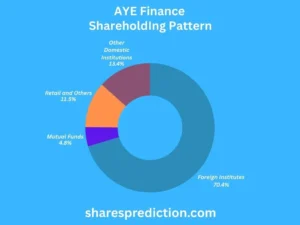
Overall, AYE Finance’s shareholding pattern indicates strong institutional backing with controlled retail exposure, supporting governance and long-term financial stability.
Conclusion
AYE Finance share price target from 2026 to 2050 highlights a growth-oriented but risk-sensitive investment profile. The company displays potential for growth through its improved profitability and increased MSME market presence and rising net worth. The organization needs to track its credit quality management and leverage levels as critical elements for assessment. Before making investments in NBFC stocks, long-term investors must first assess their capacity to handle risk.
FAQs About AYE Finance
1. What does AYE Finance specialize in?
AYE Finance provides business loans primarily to micro and small enterprises across India.
2. Is AYE Finance profitable?
The company has returned to profitability after earlier losses and shows improving earnings momentum.
3. What are the main risks?
High leverage, credit risk, economic slowdown, and regulatory changes.
4. Does AYE Finance pay dividends?
Currently, the company does not offer dividends and focuses on growth.
5. Is AYE Finance suitable for long-term investors?
It may suit investors with higher risk appetite who believe in long-term MSME credit growth.
Disclaimer
The information provided in this article is for educational purposes only and does not constitute financial advice. Investors should conduct their own research before making investment decisions.
Call to Action
For more long-term share price targets, valuation insights, and sector-focused analysis, visit Sharesprediction.com regularly and stay updated with India’s evolving stock market trends.
