

Biocon Limited operates as one of India’s top biopharmaceutical firms with expertise in biosimilars, generics, and research-based medical solutions. The company has established itself as a long-term growth business through its expanding international operations and its commitment to providing low-cost medicines. Investors closely track the Biocon Share Price Target to assess long-term growth potential and valuation trends.
Biocon has achieved substantial revenue growth during the past few years while its profitability has improved through success in its biologics division and international business alliances. The company’s future outlook appears positive because it maintains research investments and establishes its presence in controlled markets. This trend provides a useful reference for evaluating long-term investment potential.
Company Overview
Biocon Limited operates as one of India’s top biopharmaceutical companies which specializes in developing biosimilars and generics while conducting research-based innovations. The company established a strong international presence through its operations in regulated markets such as the United States and Europe. The biologics division of the company stands as its main growth engine which drives substantial revenue growth.
Biocon stands ready to achieve extended success because global healthcare needs currently demand affordable treatment options. Biocon’s strong R&D investments and strategic partnerships support a positive long-term outlook for its future share price target.
Profit & Revenue Analysis
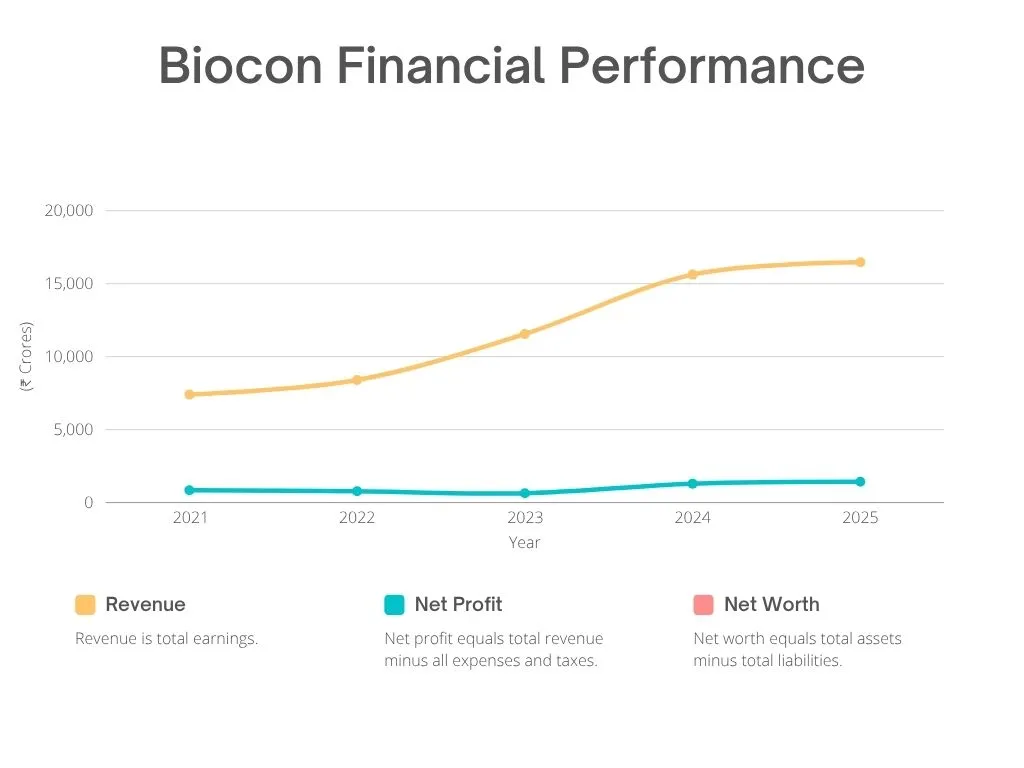
| Year | Revenue (₹ Cr) | Profit (₹ Cr) | Net Worth (₹ Cr) |
| 2021 | 7,398 | 846 | 8,508 |
| 2022 | 8,397 | 772 | 9,470 |
| 2023 | 11,550 | 643 | 22,489 |
| 2024 | 15,621 | 1,298 | 25,275 |
| 2025 | 16,470 | 1,429 | 27,713 |
Revenue growth accelerated after 2023, supported by biosimilars and global expansion. The post-2023 profit recovery shows better margins which creates a favorable outlook for Biocon Share Price Target.
Current Share Price
Financial Overview
| Metric | Value |
| Market Cap | ₹61,740 Cr |
| P/E Ratio (TTM) | 98.17 |
| P/B Ratio | 1.63 |
| Industry P/E | 31.86 |
| ROE | 1.81% |
| EPS (TTM) | ₹3.88 |
| Dividend Yield | 0.10% |
| Debt to Equity | 0.62 |
| Book Value | ₹233.84 |
| Website: | BIOCON |
Investors perceive Biocon’s future growth potential which leads them to establish a high P/E ratio for the company. Biocon Share Price Target growth is expected to depend on the company’s ability to increase both ROE and profitability.
Factors Affecting Biocon Share Price
Several key factors influence the company’s future growth and valuation which include fundamental factors, industry factors, and macroeconomic factors. Investors who understand these drivers could make better decisions about their investments.
1. Growth in Biosimilars Segment
Biocon’s biosimilars business serves as its primary revenue growth driver. The rising worldwide need for low-cost biologic medications especially benefits Biocon’s revenue stream from developed markets in the United States and Europe. The combination of product approvals with their subsequent market introduction supports future revenue growth and valuation.
2. Regulatory Approvals & Compliance
The pharmaceutical industry relies on regulatory bodies such as the US FDA and EMA to grant their necessary approvals. The stock performance may suffer from any delay or rejection but successful approvals will generate strong upward movement for the Biocon Share Price Target.
3. R&D Investment and Innovation
Biocon allocates its financial resources toward research and development activities which help create new products for their business operations. The launch of successful drugs through breakthrough innovations will create future earnings potential that will increase time-based value for the Biocon Share Price Target.
4. Profit Margins & Cost Efficiency
Operating margin improvement serves as a vital element. The company faces reduced profitability through rising costs and pricing pressure while efficiency gains create financial benefits. Long-term growth sustainability for the Biocon Share Price Target needs margin expansion to succeed.
5. Global Market Expansion
Biocon’s entry into international markets creates pathways for the company to develop new market segments and grow its business. The company’s growth potential may improve over time due to strong export performance and worldwide pharmaceutical company partnerships.
6. Currency Fluctuations
The company generates a major part of its revenue through exports so currency fluctuations directly affect its profit margins. These factors play an important role in determining future growth and valuation.
7. Industry Trends & Competition
8. Debt and Financial Stability
Biocon maintains financial stability through its moderate debt levels and its improving fiscal strength. The Biocon Share Price Target receives positive effects from effective capital management which enables the company to achieve steady growth.
Biocon Share Price Target 2026
The Biocon Share Price Target 2026 is expected to be in the range of ₹420 – ₹480.
BIOCON Share Price Target 2030
The BIOCON share price target 2030 could reach ₹550 – ₹650.
The company may achieve better international standing throughout the biopharmaceutical sector by this point. The biosimilars market and specialty pharmaceutical services and contract research services business will drive the company revenue growth. The company may achieve higher market value after its profits increase and it receives more regulatory approvals.
BIOCON Share Price Target 2035
The BIOCON share price target 2035 may reach ₹900 – ₹1,100.
Biocon is positioned to become a leading global player in biologics and biosimilars throughout the coming years. The company may achieve continuous revenue growth through its international market expansion and strong research and development capabilities and upcoming product launches. The company could achieve higher profits because of its operational efficiency improvements which may also increase investor trust.
BIOCON Share Price Target 2040
The BIOCON share price target 2040 is estimated between ₹1,400 – ₹1,700.
The company may achieve benefits from the current global demand for low-cost healthcare products during this period. The company could improve long-term growth through its partnerships and research capabilities and product development activities. The company may see consistent earnings growth which may result in long-term stock price increases.
BIOCON Share Price Target 2045
The BIOCON share price target 2045 could range between ₹2,100 – ₹2,500.
The company may achieve future growth through its innovative activities and successful drug development and its entry into new markets. The company may achieve ongoing revenue growth because of its strong product pipeline and international operations.
BIOCON Share Price Target 2050
The BIOCON share price target 2050 may reach ₹3,000 – ₹3,800.
Shareholding Pattern
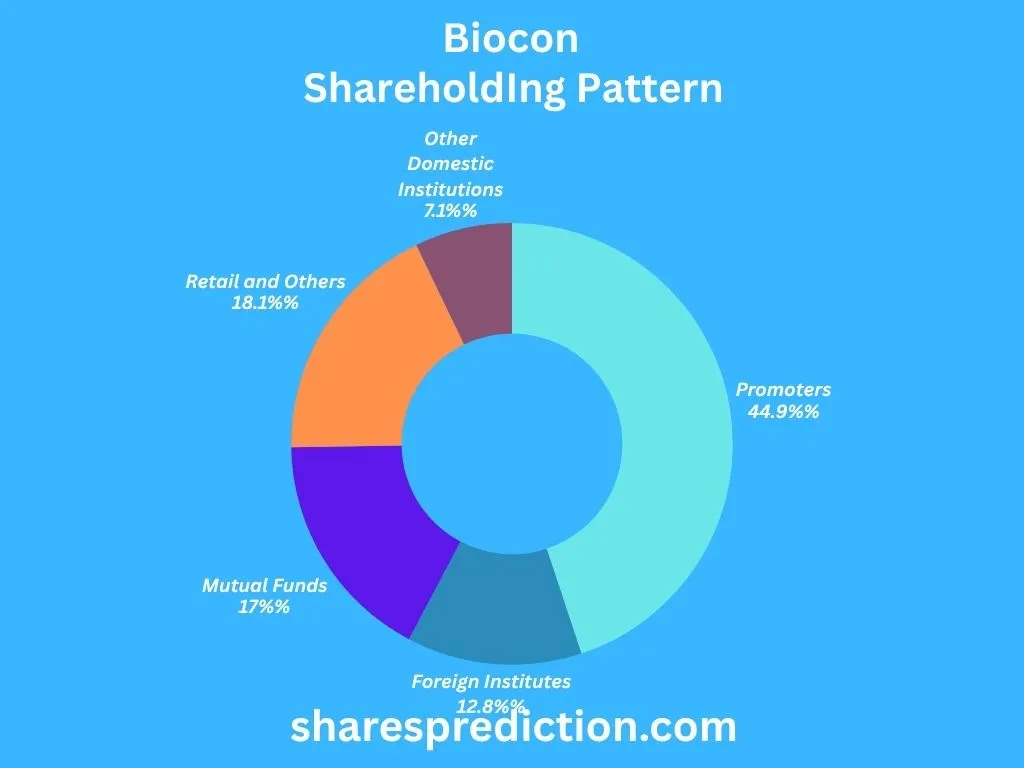
| Category | Holding |
| Promoters | 44.91% |
| Retail & Others | 18.11% |
| Mutual Funds | 17.03% |
| Foreign Institutions | 12.81% |
| Other Domestic Institutions | 7.13% |
Biocon’s shareholding structure demonstrates that the promoters maintain their ownership while institutional investors maintain their partial investment in the company. Promoters hold a significant stake which ensures they may remain dedicated to the business for an extended period. The company has gained international confidence through its mutual funds and foreign institutional investors who maintain substantial investments. Retail investors make their own contributions to market liquidity. The company maintains stability through its ownership distribution which helps determine the BIOCON Share Price Target 2026.
Conclusion
FAQs About BIOCON
What is the Biocon Share Price Target 2026?
The Biocon Share Price Target 2026 is expected between ₹420 and ₹480.
Is Biocon good for long-term investment?
Yes, due to its strong presence in biologics and global markets.
Why is Biocon’s P/E ratio high?
High growth expectations and future earnings potential drive valuation.
What are the risks?
Regulatory delays, margin pressure, and global competition.
