

The IREDA share price target 2050 marks the conclusion of India’s multi-decade renewable energy transition. Indian Renewable Energy Development Agency (IREDA), a government-backed PSU under the Ministry of New and Renewable Energy (MNRE), is likely to remain a cornerstone organization in funding clean energy projects long beyond mid-century.
By 2050, India plans to achieve profound decarbonisation, with renewable energy, storage, and clean fuels becoming the backbone of the power ecosystem. In such a situation, IREDA’s function switches from fast development to scale management, asset optimization, and long-duration capital deployment, making it relevant even in a mature energy sector.
This paper gives a structured view on the IREDA share price target 2050, based on long-term compounding assumptions, execution track record, and policy-backed relevance.
IREDA Share Price Target 2050
Taking into consideration stable profits compounding, balance sheet maturity, and continued demand for green financing, the IREDA share price target 2050 is forecasted as follows:
IREDA Share Price Target 2050
- Conservative Case: ₹1,800
- Base Case: ₹2,000
- Optimistic Case: ₹2,200
These estimates assume moderate valuation multiples, steady asset quality, and predictable financing demand rather than rapid re-rating.
IREDA’s Role in a Post-Transition Energy Economy
By 2050, India’s renewable energy transition is predicted to be essentially complete, with clean energy dominating power production and storage facilities completely integrated into the grid.
In this phase, IREDA’s business focus is expected to evolve toward:
-
Refinancing and replacement of ageing renewable assets
-
Financing next-generation storage and grid modernisation
-
Supporting clean fuel ecosystems such as green hydrogen
-
Managing long-duration infrastructure capital efficiently
This evolution supports continued relevance for the IREDA share price target 2050, even in a slower-growth but highly stable environment.
Current Market Overview
IREDA Fundamentals
| Fundamental Metric | Value |
|---|---|
| Market Capitalisation | ₹38,262 Cr |
| P/E Ratio (TTM) | 22.22 |
| P/B Ratio | 2.96 |
| Industry P/E | 21.16 |
| Debt to Equity | 5.41 |
| Return on Equity (ROE) | 13.34% |
| EPS (TTM) | ₹6.13 |
| Dividend Yield | 0.00% |
| Book Value | ₹46.00 |
| Face Value | ₹10 |
Projected Growth Path From 2026 to 2050
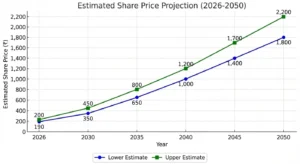
The IREDA share price target 2050 is grounded in a gradual, multi-phase growth trajectory that reflects long-term compounding across price and fundamentals.
Long-Term Projection Overview
| Year | Est. Share Price (₹) | Revenue Outlook | EPS Trend | ROE Range |
|---|---|---|---|---|
| 2026 | 190 – 200 | Stable expansion | Early growth | ~13–14% |
| 2030 | 350 – 450 | Strong growth | Rising steadily | ~14–15% |
| 2035 | 650 – 800 | Accelerated scale | Meaningful expansion | ~15–16% |
| 2040 | 1,000 – 1,200 | Mature growth | High stability | ~16–17% |
| 2045 | 1,400 – 1,700 | Predictable compounding | Sustained earnings | ~17–18% |
| 2050 | 1,800 – 2,200 | Optimised maturity | Stable long-term EPS | ~18–19% |
What This Projection Suggests
- Share price growth corresponds with profits and balance sheet compounding
- Revenue expansion slows post-2040 but becomes more reliable
- EPS and ROE stabilize at higher levels, supporting valuation durability
- By 2050, IREDA works as a low-volatility, infrastructure-grade PSU
This trend represents the financial backbone of the IREDA share price objective 2050.
What Type of Investor IREDA Is Best Suited For
By 2050, IREDA is best suited for patient, long-term investors who value stability and predictable compounding over short-term price volatility. As a mature renewable finance PSU, IREDA is expected to behave more like an infrastructure asset than a high-growth stock.
IREDA May Suit Investors Who:
-
Prefer long-term wealth compounding rather than quick returns
-
Are comfortable holding through market and valuation cycles
-
Seek exposure to India’s clean energy and infrastructure financing theme
-
Value policy-backed stability and lower business risk
-
May benefit from higher dividend payouts in a post-growth phase
Growth vs Risk Snapshot (2050 View)
🚀 Growth Positives
- Long-duration demand for renewable and storage financing
- Refinancing and asset lifecycle funding opportunities
- Policy-backed relevance even after energy transition completion
- Access to global climate and infrastructure capital
⚠️ Long-Term Risks
- Lower growth rates in a mature energy ecosystem
- Interest rate cycles impacting margins intermittently
- PSU valuation caps in conservative market phases
Overall, risks are expected to be structural but manageable,
supporting long-term resilience.
Conclusion: IREDA Share Price Target 2050
The IREDA share price target 2050 of ₹1,800–₹2,200 reflects a realistic end-state scenario where IREDA operates as a mature, stable, and systemically important renewable finance PSU. While growth rates may moderate compared to earlier decades, predictability, policy alignment, and earnings durability become the defining strengths.
For investors with an ultra-long-term horizon, IREDA represents infrastructure-style compounding rather than speculative upside.
To understand how this projection fits into the broader timeline, refer to our complete pillar analysis on IREDA share price target 2026 to 2050, which connects short-, medium-, and long-term expectations.

FAQs
1. What is the IREDA share price target 2050?
The projected IREDA share price target 2050 ranges between ₹1,800 and ₹2,200, based on long-term compounding assumptions.
2. Can IREDA remain relevant till 2050?
Yes, IREDA’s role evolves from growth financing to asset optimisation and refinancing in a mature renewable ecosystem.
3. Will IREDA’s growth slow down after 2040?
Growth may moderate, but earnings stability and predictability are expected to improve.
4. Is IREDA suitable for ultra-long-term investors?
Yes, IREDA suits investors seeking infrastructure-style returns over decades.
5. How will earnings support the share price by 2050?
EPS is expected to stabilise at higher levels, supporting durable valuations.
6. Does government ownership remain important long term?
Yes, government backing ensures policy continuity and funding access.
7. What happens to ROE by 2050?
ROE is projected to stabilise in the 18–19% range, reflecting operational maturity.
8. Can institutional ownership increase by 2050?
Gradual institutional participation is likely as earnings visibility improves.
9. What are the biggest long-term risks for IREDA?
Interest rate cycles, slower growth in a mature market, and PSU valuation caps.
10. Is IREDA likely to be a multibagger by 2050?
IREDA is more likely to deliver steady, long-duration compounding than extreme multibagger return.
⚠️ Disclaimer
The information provided in this blog is for educational purposes only and does not constitute financial advice.
Investors should research and consult with a financial advisor before making investment decisions.
Call to Action
Stay updated with the latest trends and forecasts by visiting sharesprediction regularly. Our comprehensive analyses and insights can help you make informed investment decisions.
