


IRFC share price target 2030 continues to attract strong interest from long-term investors who believe in India’s railway expansion and infrastructure transformation. The Indian Railway Finance Corporation (IRFC) is the main source of finance for big railway construction projects. It has become quite important after doing so well in the previous few years.
IRFC is at the financial center of India’s efforts to modernize its infrastructure via high-speed trains, dedicated freight routes, electrification, and the reconstruction of world-class stations. This puts the stock in a very important position for long-term growth over the next ten years.
This article gives a thorough prediction and analysis of the predicted IRFC share price target for 2030. It does this by looking at performance data, technical patterns, growth drivers, risks, and typical concerns that investors have.
Current Market Performance
| Metric | Current Value |
|---|---|
| Market Cap | ₹1,52,575 Cr |
| P/E Ratio (TTM) | 22.32 |
| Industry P/E | 25.92 |
| P/B Ratio | 2.72 |
| Debt to Equity | 7.25 |
| ROE | 12.16% |
| EPS (TTM) | 5.23 |
| Dividend Yield | 1.37% |
| Book Value | ₹43 |
| Face Value | ₹10 |
IRFC Share Price Target 2030
Considering IRFC’s predictable business model, long-term revenue visibility, stable profitability, strong government support, and infrastructure-based growth, the IRFC share price target 2030 is projected to be:
₹420 to ₹480
This range reflects a balanced outlook based on earnings compounding, policy continuity, and valuation expansion supported by India’s railway transformation.
Projected Valuation Metrics for IRFC
Assuming the stock price reaches ₹420–₹480 by 2030, with expected compounding and moderate valuation expansion:
| Metric | Current | Estimated 2030 |
|---|---|---|
| Share Price | ₹120–₹140 | ₹420–₹480 |
| EPS | 5.23 | 12–15 |
| P/E Ratio | 22.32 | 28–32 |
| Book Value | ₹43 | ₹85–₹100 |
| ROE | 12.16% | 14–16% |
| Market Cap | ₹1.52 Lakh Cr | ₹4.8–₹5.2 Lakh Cr |
Why Long-Term Investors Are Targeting 2030
Investors focusing on IRFC beyond 2025 are looking at the broader opportunity created by:
- Multi-year railway modernization spending
- Consistent asset and leasing expansion
- Re-rating of quality PSU companies
- Strong visibility in future cash flows
- Wider retail and institutional participation
IRFC is positioned as a long-term compounding stock, more suited for multi-year holders than short-term traders.
Current Shareholding Structure
Here is the shareholding pattern for the Indian Railway Finance Corporation (IRFC) as of the latest available data:
| Shareholder Category | Shareholding (%) |
|---|---|
| Promoters | 86.36% |
| Retail and Others | 11.67% |
| Foreign Institutions | 1.08% |
| Other Domestic Institutions | 0.71% |
| Mutual Funds | 0.18% |
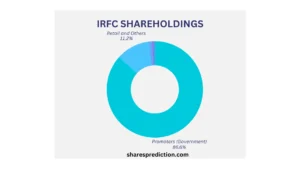
Strong government backing provides a promising factor for the long term investors.
Growth Drivers Supporting the IRFC Share Price Target 2030
1. Multi-decade Railway Capex
Projects like bullet trains, dedicated freight corridors, and station redevelopment require heavy funding—much of which flows through IRFC.
2. Long-term Lease-Based Income Model
IRFC leases assets directly to Indian Railways on long-term structured contracts, ensuring predictable income.
3. Strong Government Backing
Sovereign protection makes IRFC one of the lowest-risk financing institutions in the country.
4. Expanding Asset Base
Every new locomotive, coach or wagon financed adds long-term returns.
5. Structural PSU Re-Rating
High quality PSU stocks are seeing renewed investor confidence and valuation upgrades.
Risks to Consider
- Delay or slowdown in railway capex expenditure
- Higher borrowing cost due to rising interest rates
- Short-term volatility after large rallies
- Dependence on a single customer (Indian Railways)
While these factors may affect short-term price movement, the long-term case remains strong.
Conclusion
IRFC continues to stand out as a stable, government-backed PSU with consistent performance and predictable future growth. Supported by India’s aggressive infrastructure vision, IRFC has the strength to deliver sustained returns over the coming years.
Based on financial strength and future growth positioning, the irfc share price target 2030 is projected to be ₹420 to ₹480, making IRFC a compelling stock for long-term investors.
For a detailed multi-decade view including 2025, 2035, 2040, 2045, and 2050 targets, you can explore the full analysis here:
IRFC Share Price Target 2025–2050
FAQs on IRFC Share Price Target 2030
1. What is the IRFC share price target 2030?
The projected IRFC share price target 2030 is in the range of ₹420 to ₹480.
2. Can IRFC reach ₹500 by 2030?
If earnings accelerate faster than expected and valuations expand, ₹500 is possible.
3. Is IRFC a safe long-term stock?
Yes, due to sovereign backing and predictable lease-based revenue.
4. Why did IRFC rise sharply in 2024?
Because of PSU re-rating, rising railway capex and strong investor sentiment.
5. Will IRFC benefit from high-speed rail projects?
Yes, IRFC is expected to be a key financing contributor.
6. Does IRFC pay dividends?
Yes, IRFC distributes regular dividends and is considered a stable dividend payer.
7. What can negatively affect IRFC before 2030?
Capex slowdown, rising borrowing costs and policy shifts.
8. Is IRFC suitable for SIP investing?
Yes, because it works well for long-term accumulation during market dips.
9. Can IRFC be a multibagger by 2030?
Long-term compounding may create multibagger-level returns from lower price points.
Disclaimer
The information provided in this blog is for educational purposes only and does not constitute financial advice. Investors should research and consult with a financial advisor before making investment decisions.
Call to Action
Stay updated with the latest trends and forecasts by visiting sharesprediction regularly. Our comprehensive analyses and insights can help you make informed investment decisions.
