

Investors searching for Oil India Share Price Target 2026 are often looking to understand the company’s future growth potential, financial strength, and long-term investment viability. Oil India Limited is one of India’s leading government-owned oil and gas companies engaged in exploration and production across domestic and international markets.
The Ministry of Petroleum and Natural Gas oversees Oil India which operates as a Maharatna public sector enterprise that supports India’s energy security needs.
The company conducts its business operations throughout India while also engaging in international oil and gas exploration activities. Oil India will remain a major player in developing India’s energy infrastructure because of rising global energy needs and the country’s requirement for local energy resources.
The article will present an analysis of Oil India share price target 2026, 2030, 2035, 2040, 2045, 2050 together with an examination of the company’s financial performance basic business operations and long-term growth potential.
Company Overview
Oil India Limited (OIL) operates as a state-owned company which conducts oil and gas exploration activities while producing these resources from its facilities located in Duliajan Assam. The company was established in 1959 and operates under control of the Indian government.
Oil India conducts multiple important operations which include:
- Exploration of crude oil and natural gas
- Development of hydrocarbon reserves
- Production of petroleum and natural gas
- Pipeline transportation of crude oil
- Production of LPG and other petroleum products
The company holds the position of India’s second-largest national oil and gas company through its production and reserve achievements.
Oil India operates across multiple domestic oil fields in states like Assam and Arunachal Pradesh and Rajasthan while also participating in international projects in Russia and Mozambique and the Middle East.
Oil India functions as a vital organization for India’s energy security because it receives strong governmental support and holds crucial energy sector functions.
Profits and Revenue
Oil India has delivered strong financial performance over the past several years because crude oil prices have increased and energy demand has grown.
Oil India Financial Performance (₹ Crore)
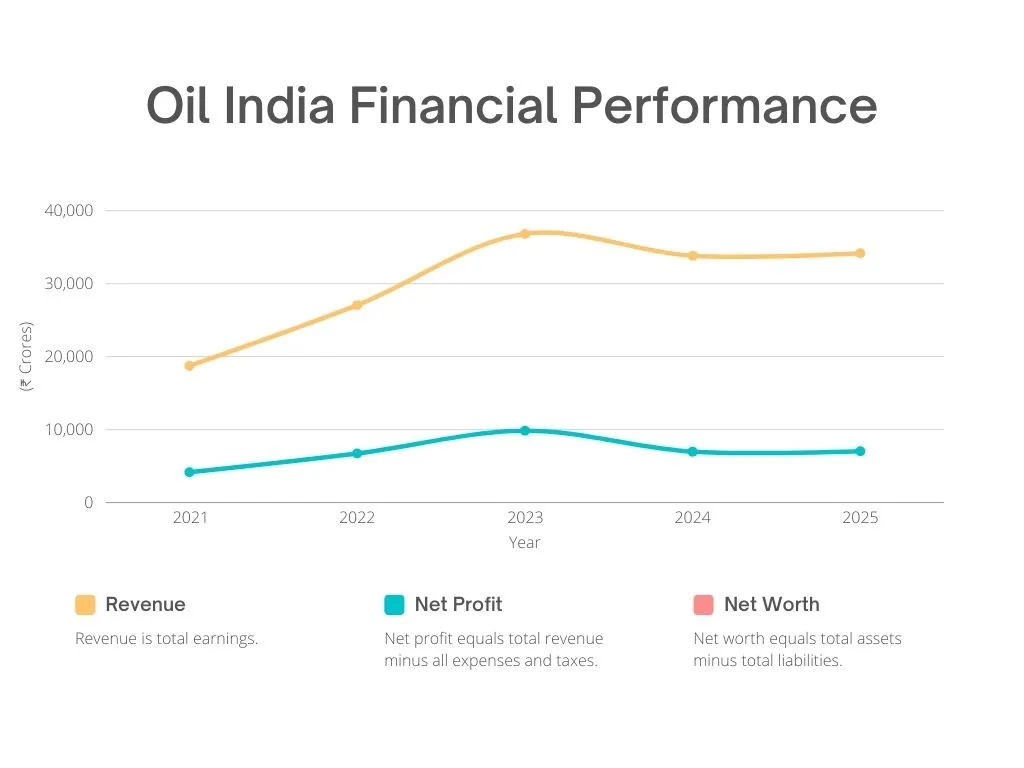
| Year | Revenue | Net Profit |
| 2021 | 18,722 | 4,146 |
| 2022 | 27,048 | 6,719 |
| 2023 | 36,817 | 9,854 |
| 2024 | 33,809 | 6,980 |
| 2025 | 34,179 | 7,040 |
The company’s revenue growth has been primarily driven by rising crude oil prices, improved production efficiency, and stable demand in domestic markets.
Oil India reported peak revenue of ₹36,817 crore and net profit of ₹9,854 crore in FY2023, reflecting strong operational performance. It generates steady earnings because its various exploration projects enable it to operate during periods of oil price fluctuations.
The company achieved financial growth because its net worth grew from ₹24,810 crore in 2021 to more than ₹54,706 crore in 2025.
Current Share Price
Financial Overview
| Metric | Value |
| Market Cap | ₹78,516 Cr |
| P/E Ratio (TTM) | 11.85 |
| P/B Ratio | 1.40 |
| ROE | 10.62% |
| EPS (TTM) | ₹40.72 |
| Dividend Yield | 2.38% |
| Debt to Equity | 0.64 |
| Industry P/E | 9.56 |
| Book Value | ₹345.86 |
| Face Value | ₹10 |
| Website: | Oil India Limited |
Oil India has relatively strong fundamentals with moderate debt and consistent profitability. The company also provides regular dividends, which makes it attractive for long-term investors seeking stable returns.
Factors Affecting Oil India Share Price
Global Crude Oil Prices
The company’s financial results depend on international crude oil prices which determine both its revenue and its profit margins. Higher oil prices generally increase the company’s earnings.
Exploration and Production Growth
The discovery of new oil and gas reserves enables the company to expand its production capacity which leads to greater revenue generation.
Government Policies
The energy policies and regulatory frameworks that govern government-owned companies restrict Oil India which operates as a state-owned enterprise.
Global Energy Demand
The growing worldwide need for oil and natural gas resources will create positive effects on the company’s output capacity and financial earnings.
Renewable Energy Transition
The global transition towards renewable energy may impact long-term demand for fossil fuels. Oil India is gradually exploring cleaner energy opportunities to remain competitive in the evolving energy landscape.
Oil India Share Price Target 2026
The Oil India share price target 2026 is expected to range between ₹520 – ₹580.
Oil India is likely to benefit in the short term from stable crude oil prices and strong domestic demand. India continues to rely heavily on oil and natural gas for transportation, manufacturing, and electricity generation. Oil India can achieve production increases through its exploration initiatives which operate in both domestic and international territories.
The stock price will approach its upper limit if oil prices stay advantageous and the company maintains its progress in operational efficiency.
This estimate is based on stable crude oil prices, consistent production levels, and steady domestic demand growth.
Oil India Share Price Target 2030
The Oil India share price target 2030 could reach ₹850 – ₹1,000.
India’s rising industrialization and energy demand are expected to support long-term growth, which can positively influence Oil India Share Price Target 2030.
Oil India stands to gain from its status as a leading domestic crude oil and natural gas producer because of rising production levels and better energy infrastructure systems.
Oil India Share Price Target 2035
The Oil India share price target 2035 may reach ₹1,300 – ₹1,500.
Oil India will expand its exploration activities together with its production capacity growth by this time.
Technological advancements in oil exploration and extraction will lead to better operational efficiency and lower production costs according to the upcoming improvements.
Oil India Share Price Target 2040
The Oil India share price target 2040 is estimated between ₹2,000 – ₹2,300.
Global energy demand growth together with rising energy infrastructure investments will drive long-term growth for the company.
Oil India Share Price Target 2045
The Oil India share price target 2045 could range between ₹2,900 – ₹3,300.
Oil India will experience benefits from ongoing global energy demand if it expands its exploration projects and boosts its oil and gas production capabilities.
Oil India Share Price Target 2050
The Oil India share price target 2050 will reach between ₹4,200 and ₹4,800.
The company’s future growth prospects depend on its success in developing environmentally friendly energy solutions while it continues to produce oil and gas.
Shareholding Pattern
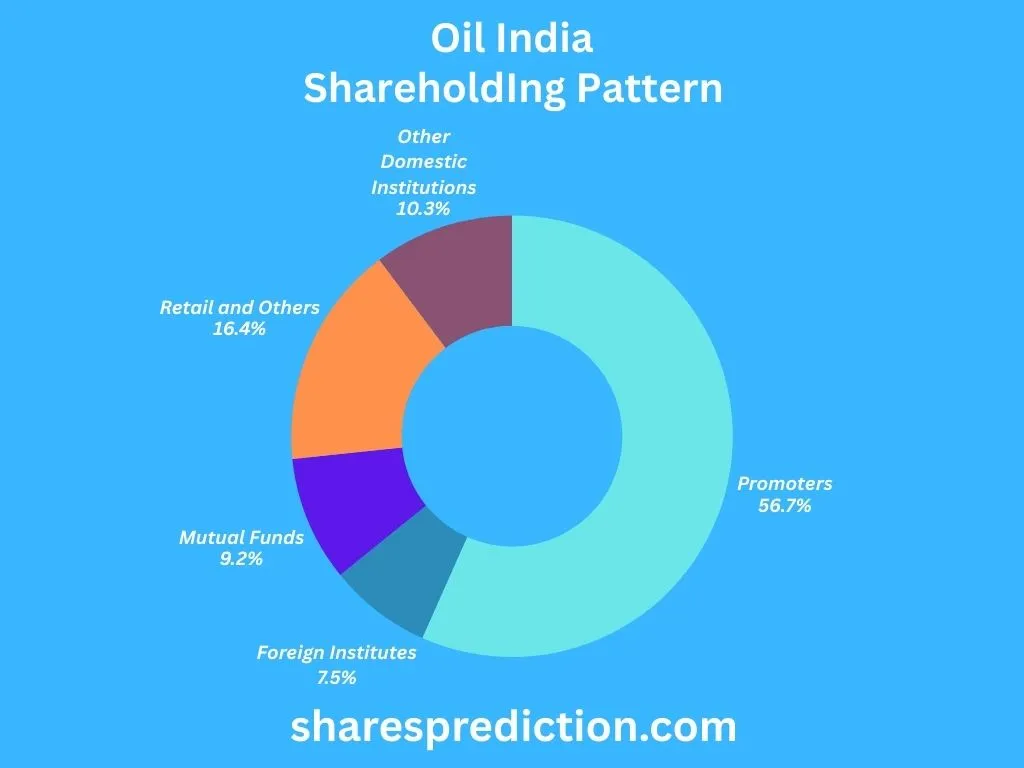
| Category | Holding (%) |
| Promoters | 56.66% |
| Retail and Others | 16.38% |
| Other Domestic Institutions | 10.26% |
| Mutual Funds | 9.17% |
| Foreign Institutions | 7.53% |
The Government of India controls approximately 56.66% of Oil India’s shares which establishes strong promoter backing for the company.
High promoter ownership usually signifies that the government will support the company’s operations with steady funding throughout the years.
The company shows strong ownership ties from institutional investors who control most of its stock. Global investors show interest in the company because mutual funds control 9.17% of its shares and foreign institutional investors hold 7.53% of its stock.
The company shows positive growth prospects because domestic institutional investors control 10.26% of its shares.
The company receives significant backing from individual investors since retail investors control approximately 16.38% of its shares.
The shareholding structure of Oil India combines promoter ownership with institutional investment, which creates a positive foundation for sustained investment stability throughout time.
Conclusion
The Oil India Share Price target 2026 shows continuous growth because of its strong financial performance and institutional support. The company benefits from increasing energy demand and its efficient operations. Investors need to assess all investment opportunities together with their associated risks. Oil India provides investors with long-term stability which makes it an appropriate choice for conservative investors who want predictable returns.
FAQs
Is Oil India a government company?
Yes, Oil India Limited is a government-owned Maharatna public sector enterprise under the Ministry of Petroleum and Natural Gas.
What does Oil India do?
Oil India conducts its operations through three main activities, which include exploration work and development activities and crude oil and natural gas production. The company’s operations include both pipeline transportation services and LPG production activities.
Is Oil India a good long-term investment?
Oil India is considered a stable long-term investment due to its government backing, consistent production levels, and regular dividend payouts. However, investors should consider risks such as oil price volatility and the global transition toward renewable energy.
Does Oil India pay dividends?
The company Oil India pays dividends on a regular basis which attracts investors who seek stocks that generate income.
