


SAIL share price target has been a very hot topic for the investors as The Steel Authority of India Limited (SAIL) is one of the largest steel-making companies in India and a major player in the country’s infrastructure and industrial development. As a public sector entity, SAIL has consistently attracted investor attention due to its strong market position and robust financials. This article focuses on the SAIL share price target for 2026, 2030, 2035, 2040, 2045, and 2050, with insights drawn from its recent financial performance and industry trends.
Company Overview
SAIL operates in the steel manufacturing sector, with a significant role in India’s infrastructure and development initiatives. Its product portfolio includes a wide range of steel products used across various industries such as construction, railways, automotive, and energy. SAIL has shown resilience in the face of market fluctuations, and its strategic importance to India’s economy places it as a critical investment option for long-term growth.
Financial Overview
Current Share Price
Revenue and Profit Growth
SAIL has demonstrated strong revenue and profit growth over the last few years, as highlighted in the table below:
| Year | Revenue (₹ Cr) | Net Profit (₹ Cr) |
|---|---|---|
| 2020 | 62,646 | 2,022 |
| 2021 | 70,122 | 3,850 |
| 2022 | 1,04,515 | 12,015 |
| 2023 | 1,05,802 | 1,903 |
| 2024 | 1,06,523 | 2,733 |
| 2025 | 1,03,354 | 2,372 |
SAIL witnessed an exceptional profit cycle in 2022 due to elevated global steel prices. However, margins normalized in 2023–2025 as steel prices corrected and raw material costs remained volatile. Despite this, SAIL has consistently maintained revenues above ₹1 lakh crore, highlighting strong demand and stable production volumes.
Fundamental Metrics (As of February 2026)
The following table summarizes SAIL’s key financial metrics:
| Metric | Value |
|---|---|
| Market Cap | ₹66,501 Cr |
| P/E Ratio (TTM) | 23.85 |
| P/B Ratio | 1.14 |
| ROE | 4.39% |
| EPS (TTM) | ₹6.75 |
| Dividend Yield | 0.99% |
| Book Value | ₹141.09 |
| Debt to Equity | 0.58 |
| 52-Week High | ₹162.90 |
| 52-Week Low | ₹99.15 |
| Website | Steel Authority Of India Limited |
From a valuation perspective, SAIL in 2026 is trading slightly above book value, indicating fair market pricing. The company maintains a healthy balance sheet with low debt, but return ratios remain moderate due to the cyclical nature of steel margins.
Factors Influencing SAIL Share Price Target
Infrastructure and Capex Cycle
SAIL is a direct beneficiary of India’s infrastructure expansion in railways, highways, defence, ports, airports, and renewable energy. Government capital expenditure is the single biggest growth driver for SAIL.
Global Steel Price Cycle
Steel prices directly impact SAIL’s profitability. Higher realizations improve margins significantly, while price corrections compress earnings.
Operational Efficiency
Modernisation of plants, cost control, automation, and better capacity utilisation will be crucial for improving long-term profitability.
Export Markets
Expansion into export markets such as Africa and Southeast Asia can provide additional revenue streams beyond domestic demand.

SAIL Share Price Target 2026
For 2026, the SAIL share price target is estimated at ₹150 to ₹210
In 2026, SAIL is expected to benefit from stable domestic demand and ongoing infrastructure projects. While margins may remain moderate, steady revenues and improved efficiency should support gradual price appreciation.
SAIL Share Price Target 2030
Looking ahead to 2030, the SAIL share price target is projected to reach between ₹390 and ₹420. With continued government investments in infrastructure and urban development, SAIL is expected to see sustained demand for its steel products. Additionally, any expansion into new markets or improved operational efficiency could further boost its share price.
SAIL Share Price Target 2035
By 2035, the SAIL share price target is anticipated to rise to between ₹720 and ₹850. As the steel industry continues to grow globally and SAIL strengthens its position in both domestic and international markets, the company is likely to see steady growth in its share price. Expansion into renewable energy sectors or new product lines could further drive long-term growth.
SAIL Share Price Target 2040
In 2040, the SAIL share price target could increase to between ₹1275 and ₹1440. As India’s economy matures and infrastructure projects expand, SAIL’s role as a key supplier of steel will ensure continued growth in revenue and profitability. The company’s ability to adapt to changing market conditions will be crucial to achieving this share price target.
SAIL Share Price Target 2045
By 2045, the SAIL share price target is expected to be in the range of ₹1550 to ₹1700. As steel remains a critical component in infrastructure and industrial projects, SAIL is likely to benefit from long-term demand for its products. With efficient operations and a solid market position, the company’s share price is expected to appreciate steadily.
SAIL Share Price Target 2050
Looking towards 2050, the SAIL share price target is forecasted to reach between ₹2450 and ₹2600. By this time, SAIL is expected to be a leader in the global steel industry, with a diversified portfolio of products and services. The company’s consistent financial performance and ability to innovate will make it a strong investment for long-term growth.
Shareholding Pattern
As of February 2026, the shareholding pattern of SAIL is as follows:
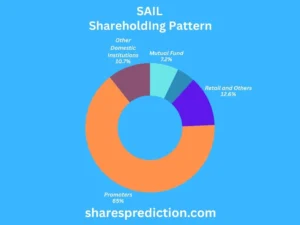
| Category | Percentage (%) |
|---|---|
| Promoters | 65.00% |
| Retail and Others | 12.63% |
| Other Domestic Institutions | 10.69% |
| Mutual Funds | 7.15% |
| Foreign Institutions | 4.53% |
High promoter holding reflects strong government ownership and strategic importance, while increasing institutional participation indicates long-term investor confidence.
Conclusion
The SAIL share price target for 2026, 2030, 2035, 2040, 2045, and 2050 indicates a promising growth trajectory. With strong financials, government support, and an increasing demand for steel, SAIL is well-positioned to offer substantial returns to investors over the long term. The company’s ability to maintain operational efficiency and capitalize on market opportunities will be key to its future success.
FAQs About SAIL
Q1. What does SAIL specialize in?
SAIL specializes in the production of a wide range of steel products used across various industries such as construction, automotive, and energy.
Q2. Is SAIL a good investment in 2026?
Yes, SAIL is considered a stable long-term investment due to infrastructure-driven demand and government support.
Q3. What is the role of the government in SAIL?
The government holds a significant stake in SAIL, with promoters owning 65% of the company’s shares.
Q4. How does global steel demand affect SAIL?
Global steel demand directly impacts SAIL’s revenue and profitability, especially with regard to exports.
Q5. Does SAIL pay dividends?
Yes, SAIL offers regular dividends, making it suitable for income investors.
Q6. What challenges does SAIL face?
SAIL faces challenges such as fluctuating global steel prices, operational efficiency, and competition from international steel producers.
Q7. What is SAIL’s revenue growth trend?
SAIL’s revenue has steadily grown, reaching ₹1,06,523 crore in 2024.
Q8. How has SAIL’s net profit changed in recent years?
SAIL’s net profit peaked at ₹12,015 crore in 2022 but has since stabilized, recording ₹2,733 crore in 2024.
Q9. What is the company’s debt position?
SAIL has a moderate debt-to-equity ratio of 0.64, indicating balanced financial management.
Q10. What is SAIL’s market capitalization?
As of 2024, SAIL’s market capitalization stands at ₹53,428 crore.
Disclaimer
The information provided in this blog is for educational purposes only and does not constitute financial advice. Investors should research and consult with a financial advisor before making investment decisions.
Call to Action
Stay updated with the latest trends and forecasts by visiting sharesprediction regularly. Our comprehensive analysis and insights can help you make informed investment decisions.
