

SBI Cards share price target is a key topic for investors tracking India’s fast-growing digital payments and consumer credit space. SBI Cards and Payment Services operates as one of India’s major credit card issuing companies which benefits from the increasing number of cashless transactions and rising consumer spending and growing usage of credit. The article presents a comprehensive long-term projection for SBI Card share price target which extends from 2026 until 2050 by using current market data and company financial results.
Company Overview
SBI Cards and Payment Services operates as a leading force in India’s credit card market because of its established brand and extensive customer network. The company operates in three main areas which include credit cards and consumer payment solutions and digital financial services. SBI Cards strengthens its market position through two factors which include growing cashless payment adoption and increasing discretionary spending by consumers. The credit growth and asset quality and profitability consistency of SBI Card operations will determine the share price target for long-term investors.
Profits and Revenue
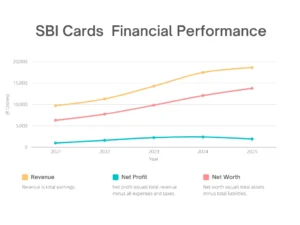
SBI Cards Financial Performance (₹ Crore)
| Year | Revenue | Net Profit | Net Worth |
|---|---|---|---|
| 2021 | 9,714 | 985 | 6,302 |
| 2022 | 11,302 | 1,616 | 7,753 |
| 2023 | 14,286 | 2,258 | 9,830 |
| 2024 | 17,484 | 2,408 | 12,084 |
| 2025 | 18,637 | 1,916 | 13,782 |
The company experiences increasing revenue and net worth because its customers use their cards more and it successfully attracts new customers, but its profits show unpredictable patterns that make credit risk management critical for the business.
Current Share Price
Financial Overview
| Metric | Value |
|---|---|
| Market Cap | ₹74,604 Cr |
| P/E Ratio (TTM) | 35.67 |
| P/B Ratio | 5.04 |
| ROE | 12.97% |
| EPS (TTM) | ₹21.98 |
| Dividend Yield | 0.32% |
| Debt to Equity | 3.33 |
| 52-Week High | ₹1,027.25 |
| 52-Week Low | ₹725.15 |
| Industry P/E | 25.33 |
| Book Value | ₹155.42 |
| Face Value | 10 |
| Website | SBI Cards |
Factors Influencing SBI Cards Share Price Target
Growth in Digital Payments
Businesses will achieve permanent revenue growth through their increasing use of credit cards and digital payment systems.
Credit Cost and Asset Quality
The company needs to handle delinquent accounts because this task directly affects its ability to maintain profitable operations through control of credit risk.
Operating Leverage
The company will achieve greater profit margins through improved operational efficiency which comes from its expanding customer base.
Competitive Landscape
The company faces strong competition which will create pricing pressure but its established brand presence will provide financial security.
SBI Cards Share Price Target 2026
SBI Cards Share Price Target 2030
The SBI Card share price target will reach between ₹1,300 and ₹1,550 by the year 2030. The company’s earnings will grow because India the credit card market continues to expand and digital transactions increase and the customer base keeps growing. The stock price will rise because long-term investors will trust the company when its profitability reaches stable levels and its return on equity improves.
SBI Cards Share Price Target 2035
SBI Cards Share Price Target 2040
The SBI Card share price target for 2040 will range between ₹2,700 and ₹3,200. The forecast shows three factors: ongoing consumer credit growth and rising digital usage and permanent profitability across different market conditions. The company needs to control its asset quality and handle new regulatory requirements.
SBI Cards Share Price Target 2045
The SBI Card share price target for 2045 is estimated between ₹3,600 – ₹4,300. The strong brand equity of SBI Cards together with its stable revenue streams and developed risk management capabilities will provide the company with its current advantages. The stock presents itself as a reliable investment option for long-term investors who seek steady growth within the financial services industry.
SBI Cards Share Price Target 2050
Looking ahead to 2050 the SBI Card share price target will reach between ₹4,800 and ₹5,800. The long-term forecast uses multiple decades of earnings growth together with expanding digital payment systems and increasing demand for consumer credit. To achieve the financial targets, it would be advisable to ensure that the firm operates profitably over the long term and to exercise credit facilities with prudence.
Shareholding Pattern
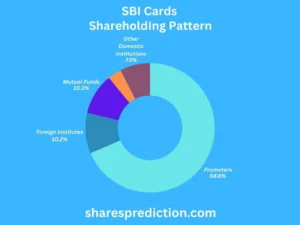
The shareholding pattern of SBI Cards and Payment Services Limited shows that promoters hold majority control while institutional investors maintain their limited stake in the company. The promoters control 68.58% of the company’s shares which demonstrates their dedication to the business and their ability to manage its operations. Professional investors show confidence in the stock because institutional investors, which include mutual funds and foreign institutions, hold a significant portion of the company. The stock market shows low retail involvement because most shares remain with promoters and institutional investors, which creates stability but results in reduced public float.
SBI Cards Shareholding Pattern
| Shareholder Category | Shareholding (%) |
|---|---|
| Promoters | 68.58% |
| Mutual Funds | 10.31% |
| Foreign Institutional Investors | 10.15% |
| Other Domestic Institutions | 7.53% |
| Retail & Others | 3.42% |
| Total | 100.00% |
This ownership structure underscores strong promoter backing with balanced institutional support, which can positively influence governance and long-term strategic execution.
Conclusion
FAQs About SBI Cards
Q1. What is SBI Cards and Payment Services?
SBI Cards and Payment Services is one of India’s leading pure-play credit card issuers, offering a wide range of credit cards and digital payment solutions across consumer segments.
Q2. What drives SBI Cards’ long-term growth?
Growth is driven by rising credit card penetration, increasing digital transactions, expanding consumer spending, and improved data-driven credit assessment.
Q3. Is SBI Cards a high-growth company?
SBI Cards is considered a long-term growth company due to India’s underpenetrated credit card market, though earnings may fluctuate with credit cycles.
Q4. Does SBI Cards pay dividends?
Yes, SBI Cards pays dividends, but the yield remains relatively low as the company prioritizes growth and reinvestment.
Q5. Is SBI Cards suitable for long-term investors?
SBI Cards may suit long-term investors who can tolerate periodic volatility and are focused on India’s expanding consumer finance ecosystem.
