


Union Bank Share Price Targets for 2026, 2030, 2035, 2040, 2045, and 2050 are critical for investors planning for the future. Union Bank of India, one of the oldest and most trusted public sector banks in India, has been a cornerstone of the country’s banking sector. As investors look forward to potential returns, understanding Union Bank’s share price targets for 2026, 2030, 2035, 2040, 2045, and 2050 becomes essential. This blog provides an in-depth analysis and expert predictions for Union Bank share price target for upcoming years, providing valuable insights for investors.
Union Bank Share Price Current Market Performance
Financial table for Union Bank
| Company Name | Union Bank of India |
|---|---|
| Market Cap | ₹ 1,29,199 Cr (As of January 2026) |
| P/E Ratio | 6.82 |
| Industry P/E | 14.15 |
| Debt to Equity Ratio | NA |
| ROE | 15.08% |
| Dividend Yield | 2.81% |
| 52 Week High | ₹ 183.34 |
| 52 Week Low | ₹ 106.63 |
| Official Website | Union |
As of 2026, Union Bank of India continues to maintain a strong position among public sector banks, supported by stable fundamentals and improving asset quality. With a market capitalization of over ₹1.3 lakh crore and a P/E ratio significantly lower than the industry average, the bank remains attractively valued from a long-term investment perspective. The healthy return on equity and consistent dividend yield further reflect Union Bank’s ability to generate sustainable shareholder value while operating in a highly regulated banking environment.
Union Bank Growth over the Past 5 years
| Year | Revenue Growth | Profit Growth | EBITDA Growth |
|---|---|---|---|
| 2021 | 83,211 | 2,828 | 64,738 |
| 2022 | 81,754 | 5,209 | 70,861 |
| 2023 | 97,079 | 8,430 | 78,804 |
| 2024 | 1,18,188 | 13,709 | 97,598 |
| 2025 | 1,29,979 | 17,921 | 1,13,834 |
Union Bank has shown consistent improvement in financial performance over the past five years, with steady growth in revenue, profits, and EBITDA. The sharp rise in profitability after 2022 highlights better asset quality, controlled NPAs, and improved operational efficiency. From a 2026 perspective, the bank appears well-positioned for sustainable growth, supported by strong credit expansion, higher net interest income, and ongoing digital transformation, which is expected to further enhance margins and strengthen long-term financial stability.

Over the past few years, Union Bank of India has shown steady improvement in its core banking metrics, particularly in profitability and asset quality. The bank has reported consistent growth in net profit, driven by better loan recoveries, controlled operating expenses, and improved net interest margins. Additionally, declining non-performing assets (NPAs) and stronger capital adequacy ratios indicate a healthier balance sheet compared to previous years.
Union Bank Share Price Target 2026
Union Bank share price target for 2026 is expected to be in the range of ₹190 to ₹210, based on current valuation levels, improving profitability, and positive sector outlook. This projection considers the bank’s stable earnings growth, declining NPAs, and increasing focus on digital and retail banking services.
The bank’s relatively low valuation compared to private peers also provides room for gradual re-rating, making Union Bank an attractive option for long-term investors seeking steady growth with lower downside risk.
Union Bank Share Price Target 2030
Union Bank share price target for 2030 is projected to be between INR 337 to INR 346, assuming steady economic growth and continued improvements in the bank’s financial performance. This long-term outlook takes into account the bank’s strategic initiatives in expanding digital services, enhancing customer experience, and improving asset quality
Union Bank Share Price Target 2035
Union Bank share price target for 2035 is projected to be between INR 516 to INR 522, contingent on sustained economic growth and the bank’s continued financial improvement. This long-term estimate reflects expectations of the bank’s successful digital transformation, enhanced asset management, and robust growth in both retail and corporate banking sectors.
Union Bank Share Price Target 2040
Union Bank share price target for 2040 is estimated to be between INR 742 to INR 771, based on anticipated long-term economic growth and the bank’s strategic advancements. This forecast considers the bank’s ongoing digital innovations, expansion of services, and effective management of assets and liabilities.
Union Bank Share Price Target 2045
Union Bank share price target for 2045 is projected to be between INR 912 to INR 962, assuming continued economic stability and the bank’s successful implementation of its strategic plans. This long-term outlook is based on the expectation that Union Bank will continue to grow through digital transformation, expanding its service portfolio, and maintaining robust financial health.
Union Bank Share Price Target 2050
Union Bank share price target for 2050 is anticipated to be between INR 1100 to INR 1240, assuming the bank continues to leverage growth opportunities and maintain strong financial performance. This long-term forecast reflects expectations of the bank’s ongoing digital advancements, expansion into new markets, and effective risk management strategies.
Investor Types and Shareholding Ratios
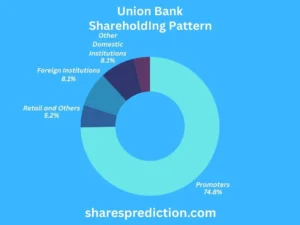
| Investor Type | Shareholding Ratio (%) |
|---|---|
| Promoters | 74.76 |
| Other Domestic Institutions | 8.08 |
| Foreign Institutional Investors (FIIs) | 8.14 |
| Mutual Funds | 3.82 |
| Retail Investors | 5.20 |
The shareholding structure of Union Bank of India reflects strong government backing, with the Government of India remaining the largest shareholder. Institutional participation from both domestic and foreign investors indicates sustained confidence in the bank’s long-term growth prospects.
The presence of FIIs and mutual funds highlights improving market sentiment towards public sector banks, driven by better financial discipline, improved asset quality, and stronger profitability metrics in recent years.
Conclusion
In conclusion, Union Bank of India, with its extensive history and significant role in India’s banking sector, presents a compelling investment opportunity for the future. These projections are underpinned by the bank’s strategic initiatives in digital transformation, expanding services, and maintaining financial health.
With a substantial government shareholding and a growing focus on enhancing profitability and customer experience, Union Bank is well-positioned for long-term growth, making it an attractive option for investors seeking stable and progressive returns.
FAQs
What is the history behind Union Bank of India?
-
- Union Bank of India was founded in 1919 in Mumbai. It was nationalized in 1969 as part of the Indian government’s initiative to promote financial inclusion and control over the banking sector.
Where is Union Bank of India’s headquarters located?
-
- The headquarters of Union Bank of India is situated in Mumbai, Maharashtra.
What are the key services offered by Union Bank of India?
-
- Union Bank of India offers a range of services including savings and current accounts, personal and business loans, credit cards, wealth management, insurance, and digital banking services.
How extensive is Union Bank of India’s branch network?
-
- Union Bank of India has an extensive network of branches and ATMs across India, making it one of the largest public sector banks in the country in terms of reach.
What is the significance of Union Bank of India’s role in financial inclusion?
-
- Union Bank of India plays a crucial role in promoting financial inclusion by providing banking services to underserved and unbanked regions, especially through its extensive branch network and digital banking platforms.
What notable awards or recognitions has Union Bank of India received?
-
- Union Bank of India has received several awards for its performance in various sectors, including digital banking, customer service, and financial inclusion.
Does Union Bank of India offer any special schemes for farmers or small businesses?
-
- Yes, Union Bank of India offers specialized schemes and financial products for farmers, small businesses, and micro-enterprises to support their growth and development.
What are the major milestones in Union Bank of India’s history?
-
- Key milestones include its founding in 1919, nationalization in 1969, and subsequent mergers with other banks like Punjab & Maharashtra Co-operative Bank (PMC) and Andhra Bank in 2020.
How does Union Bank of India contribute to social responsibility?
-
- The bank is involved in various corporate social responsibility (CSR) initiatives, including education, healthcare, and environmental sustainability programs, aimed at contributing positively to society.
What advancements has Union Bank of India made in digital banking?
-
- Union Bank of India has made significant advancements in digital banking by introducing mobile banking apps, internet banking services, and advanced payment systems to enhance customer convenience and accessibility.
Disclaimer
The information provided in this blog is for educational purposes only and does not constitute financial advice. Investors should research and consult with a financial advisor before making investment decisions.
Call to Action
Stay updated with the latest trends and forecasts by visiting sharesprediction regularly. Our comprehensive analyses and insights can help you make informed investment decisions.
