

Paytm is one of India’s leading digital payments and fintech platforms, attracting strong investor attention. Many investors are actively searching for Paytm Share Price Target to evaluate the company’s long-term growth potential in the rapidly expanding digital economy. With increasing adoption of online payments, financial services, and digital ecosystems, Paytm is well-positioned to benefit from India’s fintech revolution.
The fintech sector in India is growing rapidly due to rising smartphone penetration, government initiatives like Digital India, and increasing preference for cashless transactions. Paytm offers a wide range of services, including digital payments, financial services, lending, and wealth management. The Paytm Share Price Target for 2025, 2026, 2030, 2035, 2040, 2045 and 2050 is influenced by factors such as user growth, transaction volumes, profitability, and regulatory developments.
The company is focusing on improving operational efficiency and achieving profitability while expanding its financial services offerings. With a strong user base and diversified platform, Paytm presents significant long-term growth opportunities. This article provides a detailed analysis of its business model, financial performance, and future outlook.
Company Overview
Paytm is a technology-driven fintech company offering digital payment solutions and financial services to consumers and businesses. Its platform includes services such as mobile wallets, UPI payments, merchant solutions, lending, insurance, and wealth management. The company serves millions of users and merchants across India.
Paytm has built a strong ecosystem by integrating payments with financial services, enabling cross-selling opportunities. It focuses on expanding its merchant network and increasing user engagement through innovative digital solutions. The company is also strengthening its presence in lending and financial services to drive future growth.
With increasing adoption of digital transactions and financial inclusion, Paytm is well-positioned for long-term growth. These factors play a key role in shaping the Paytm Share Price Target and investment outlook.

Profits and Revenue
Paytm has shown strong revenue growth driven by increasing digital payment transactions and expansion into financial services. The company benefits from a large user base and growing merchant ecosystem. Growth in lending and financial services supports steady revenue performance and long-term business stability.
The company is working toward profitability through cost optimization and improved operational efficiency. Higher margins from financial services and increased scale contribute to earnings growth. These factors positively influence the Paytm Share Price Target and indicate strong long-term potential in the fintech sector.
Paytm Share Price Current Market Performance
Financial Table for Paytm
| Company Name | Paytm |
|---|---|
| Market Cap | ₹ 74,870 Cr (As of January 2026) |
| P/E Ratio | -427.60 |
| Industry P/E | 116.83 |
| Debt to Equity Ratio | 0.01 |
| ROE | 0.74% |
| Dividend Yield | 0.00% |
| 52 Week High | ₹ 1381.80 |
| 52 Week Low | ₹ 651.50 |
| Official Website | Paytm |
The following table presents the latest available financial snapshot of Paytm based on publicly available data as of 2026, helping investors assess the company’s valuation, profitability, and overall financial position.
Paytm Growth over the Past 5 years
| Year | Revenue Growth | Profit Growth | EBITDA Growth |
|---|---|---|---|
| 2021 | 3,186 | -1,701 | 6,516 |
| 2022 | 5,264 | -2,396 | 14,130 |
| 2023 | 8,400 | -1,777 | 12,993 |
| 2024 | 10,525 | -1,422 | 13,298 |
| 2025 | 7,625 | -663 | 14,997 |
Paytm has demonstrated strong revenue and EBITDA growth over the past five years, reflecting rising adoption of digital payments and financial services. Although the company has remained loss-making, the scale of losses has narrowed significantly, indicating improving operational efficiency and better cost control. From a 2026 perspective, Paytm appears to be moving steadily towards profitability, supported by higher merchant monetisation, growth in lending and insurance segments, and a stronger focus on sustainable business models.
Paytm Share Price Target 2025
The Paytm Share Price Target 2025 was estimated in the range of ₹1,015 to ₹1,315, reflecting performance in the fintech and digital payments sector.
One 97 Communications Limited operates in digital payments, financial services, and commerce platforms, benefiting from increasing digital transactions in India. The company showed gradual improvement supported by higher merchant adoption and growth in payment volumes. Its focus on profitability and expansion into financial services contributed to business stability. However, factors such as regulatory developments and competition influenced short-term price movement. Overall, the Paytm Share Price Target 2025 indicated moderate growth driven by fintech adoption.
Paytm Share Price Target 2026
The Paytm share price target for 2026 is based on expectations of operational stabilization, improving margins, and gradual progress towards profitability. The company’s performance will largely depend on its ability to monetize its large user base, expand merchant-driven reminder, and navigate regulatory requirements effectively.
Growth in digital payments, financial services distribution, and business subscriptions is expected to play a critical role in shaping Paytm’s valuation over the medium term.
Paytm Share Price Target 2030
By 2030, Paytm Share Price is expected to reach ₹1500 and ₹2000. This projection assumes favorable market conditions, continued innovation, and effective competition management. The company envisions expanding its ecosystem of financial services to cover a comprehensive range of offerings, including advanced lending solutions, diverse insurance products, and sophisticated wealth management services, all integrated into a seamless digital platform.
Paytm Share Price Target 2035
For the year 2035, Paytm Share Price is expected to reach ₹2500 to ₹3000. These estimates are speculative and subject to change based on future developments in the fintech industry and broader financial markets. Paytm’s ability to expand its financial services ecosystem, enhance profitability, and maintain a strong market position amidst evolving technological advancements and regulatory landscapes.
Paytm Share Price Target 2040
For the year 2040, Paytm Share Price is expected to reach ₹3000 – ₹5000 . This aim is continuously broadening its suite of financial products and services, including lending, insurance, and wealth management, to offer comprehensive solutions to users and businesses.
Paytm Share Price Target 2045
By 2045, Paytm Share Price is expected to reach ₹5000 to ₹7000. It assuming continued successful execution of its strategic initiatives, market expansion, technological advancements, and favorable regulatory environment.
Paytm Share Price Target 2050
By 2050, Paytm Share Price is expected to reach ₹10,000 to ₹15,000. These estimates hinge on Paytm’s ability to sustain growth, expand its market presence, innovate effectively, and adapt to future market challenges.
Investor Types and Shareholding Ratios
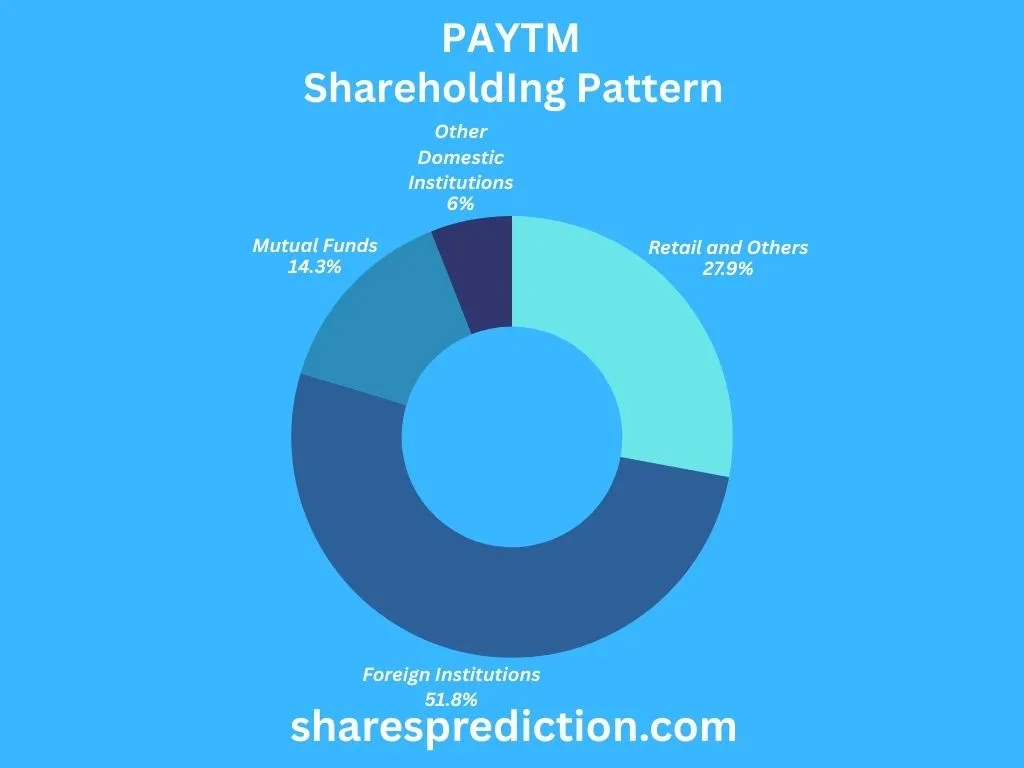
| Investor Type | Percentage of Shares (%) |
|---|---|
| Foreign Institutions | 51.76% |
| Retail and Others | 27.92% |
| Mutual Funds | 14.34% |
| Other Domestic Institutions | 5.98% |
The shareholding pattern of Paytm reflects strong participation from foreign institutional investors and mutual funds, indicating institutional confidence in the company’s long-term business model. Retail investors also hold a meaningful stake, demonstrating widespread public interest in Paytm as a leading fintech platform in India.
This diversified ownership structure supports liquidity, corporate governance, and long-term capital stability.
Conclusion
As of 2026, Paytm remains a major player in India’s digital payments and fintech ecosystem, supported by a strong brand, extensive merchant network, and widespread consumer adoption. However, the company continues to operate in a highly competitive and regulated environment, where profitability and compliance remain key challenges.
Paytm’s long-term success will depend on its ability to scale high-margin financial services, control operational costs, maintain regulatory alignment, and effectively convert its transaction volumes into sustainable revenue. For investors, Paytm represents a high-potential but high-risk fintech stock with significant upside tied to successful execution of its business strategy.
FAQs
-
Who is the founder of Paytm?
- Vijay Shekhar Sharma founded Paytm in 2010. He is also the CEO of the company.
-
What does Paytm stand for?
- Paytm stands for “Pay Through Mobile.”
-
What are some of the key services offered by Paytm?
- Paytm offers a variety of services including mobile recharges, utility bill payments, travel bookings, online shopping, and financial services such as banking, insurance, and mutual funds.
-
How did Paytm evolve from a recharge platform to a financial services giant?
- Paytm started as a mobile recharge platform and expanded its services to include online bill payments, e-commerce, and financial services. The launch of the Paytm wallet in 2014 marked a significant expansion into digital payments, and subsequent developments like Paytm Payments Bank and Paytm Money further solidified its position in the financial sector.
-
What is Paytm Payments Bank, and how does it differ from traditional banks?
- Paytm Payments Bank is a new model of banking introduced by the Reserve Bank of India. It offers all the banking services except lending and issuing credit cards. It focuses on digital transactions and offers benefits like zero balance accounts and high-interest savings accounts.
-
What role did Paytm play during the demonetization period in India?
- During the 2016 demonetization in India, Paytm saw a significant increase in user adoption as people shifted to digital payments due to the cash shortage. The company’s tagline “Paytm Karo” became synonymous with digital payments during this period.
-
What is Paytm Mall, and how does it function?
- Paytm Mall is Paytm’s e-commerce platform, offering a wide range of products from electronics and fashion to groceries. It combines the convenience of online shopping with the trust of a retail experience, including features like verified sellers and easy returns.
-
What initiatives has Paytm taken for financial inclusion?
- Paytm has launched various initiatives for financial inclusion, such as providing banking services to the unbanked population, offering small loans and micro-insurance, and setting up Paytm Ka ATM outlets to help people access banking services in remote areas.
-
What are Paytm’s international ventures?
- Paytm has expanded its services internationally through its subsidiary One97 Communications. It has invested in startups and collaborated with companies in countries like Canada and Japan to offer similar digital payment and financial services.
-
How does Paytm ensure the security of its users’ data?
- Paytm employs multiple layers of security measures, including encryption, two-factor authentication, and regular security audits, to protect users’ data. They also provide guidelines and support to help users recognize and avoid potential scams.
Disclaimer
The information provided in Paytm Share Price Target for 2025, 2026, 2030, 2035, 2040, 2045 and 2050 blog is for educational purposes only and does not constitute financial advice. Investors should research and consult with a financial advisor before making investment decisions.
Call to Action
Stay updated with the latest trends like Paytm Share Price Target 2025, 2026, 2030, 2035, 2040, 2045, 2050 and forecasts by visiting sharesprediction regularly. Our comprehensive analyses and insights can help you make informed investment decisions.
